What mtDNA Actually Is
- mtDNA (mitochondrial DNA) is found in the mitochondria — the energy centres of our cells.
- Unlike the rest of our DNA, it doesn’t recombine.
- It passes unchanged from mother to child, so daughters carry the same mtDNA as their mothers, grandmothers, great‑grandmothers, and so on.
- Because it mutates very slowly, it preserves a deep-time signature of maternal ancestry.
This is why mtDNA can hint at where a maternal line has been for thousands of years, even when written records only go back a few generations.
🧬 What Is a Haplogroup?
A haplogroup is a genetic branch — a way of grouping people who share a very ancient maternal ancestor.
Think of it like:
- a tree (humanity)
- with big branches (major haplogroups)
- and smaller twigs (sub‑branches like K1a2a5a)
Your haplogroup doesn’t tell you who your recent ancestors were, but it does show the deep path your maternal line travelled over thousands of years.
🌍 Where Haplogroup K1a2a5a Is Found
K1a2a5a is rare, but where it appears, it tends to cluster in:
- Ireland (especially the northwest)
- Scotland
- parts of Atlantic Europe
- pockets of Scandinavia
- and occasionally in diaspora communities descended from these regions
It’s a pattern that fits the story of small, stable coastal communities — places where women stayed rooted for generations.
Fanad, mtDNA, and the deep roots of a maternal line
Long before surnames were anglicised or families scattered across the world, the women of my line were already rooted in Fanad.
I’ve solved a few family mysteries over the years using DNA — mostly autosomal, the cousin‑finder beloved of Ancestry, MyHeritage and the rest. But lately I’ve been thinking about a different kind of inheritance: my mtDNA, the thread passed from mother to mother to mother, unchanged for thousands of years.
Autosomal DNA is brilliant for finding cousins and breaking brick walls, but it’s noisy — it shuffles every generation.
mtDNA doesn’t.
It’s a quiet, steady signal that moves down the maternal line like a lantern passed from hand to hand.
For my mother, every recorded generation sits in or near Fanad, in the north of Co. Donegal. Parish registers take me back through the women of my line — Logue, Coll, McAteer, Mac Glásín (later flattened into Green by English record‑keepers). Each name another step into the same few townlands.
But mtDNA reaches deeper than any register.
It carries a memory older than writing.
My mtDNA belongs to a rare branch called K1a2a5a. Haplogroup K itself is ancient — part of the Neolithic movement of farming peoples into Europe. The sub‑branches formed slowly over thousands of years, splitting and settling as small groups of women stayed rooted in particular landscapes.
What this means, in simple terms, is this:
The maternal line I carry today may have been in places like Fanad for millennia — long before surnames, long before the idea of Ireland as a nation, long before any written record.
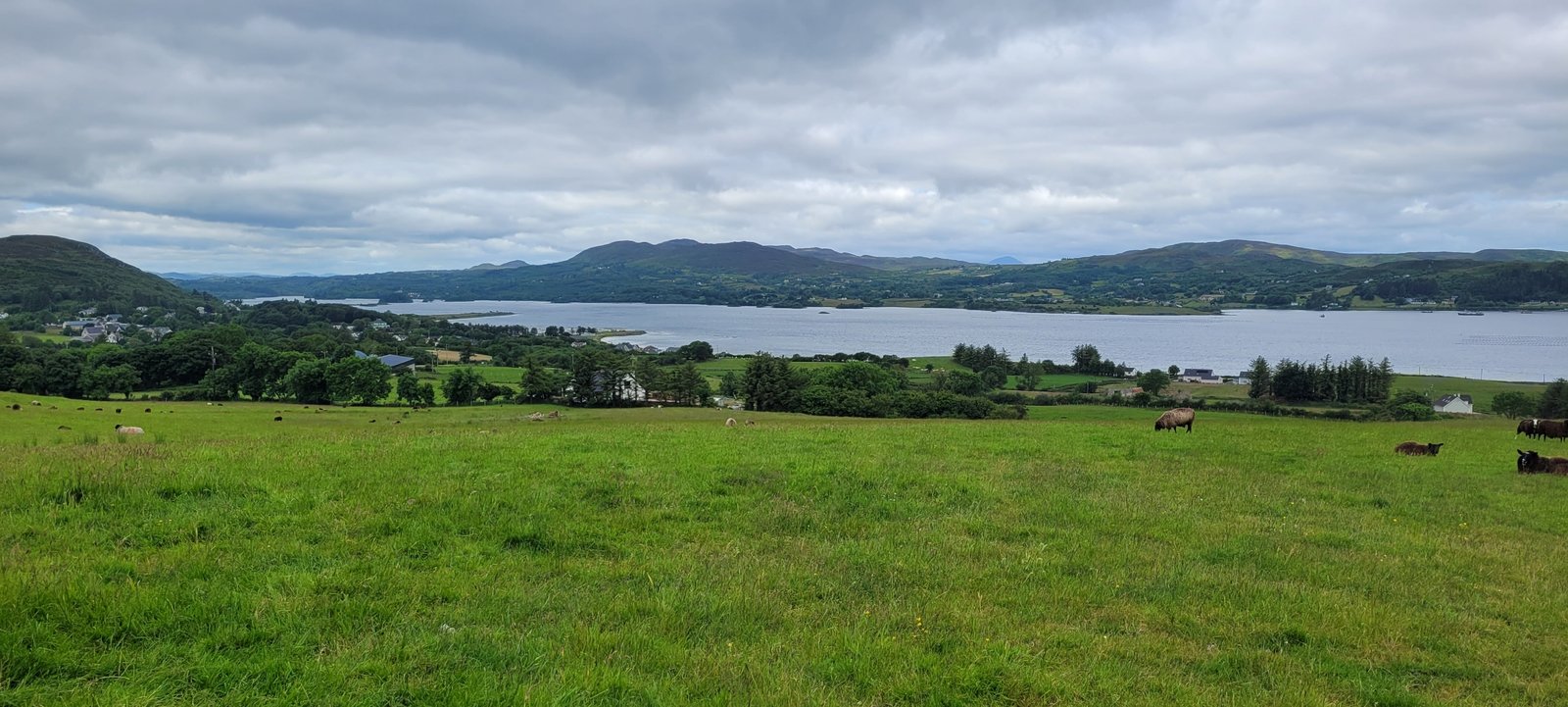
My mother was from Kerrykeel — An Cheathrú Chaol, “the narrow quarter” — a name that fits the landscape perfectly. A slim strip of land between Mulroy Bay and the hills, where families didn’t move far unless famine pushed them to the USA, Australia, New Zealand, Scotland, England, or sometimes Wales. Generations lived close to each other, rooted in the same fields, the same shorelines, the same hills.
When I stand there now — looking across Mulroy Bay, or up towards Cnoc Alla — I’m looking at a view my maternal ancestors would have known for a thousand years or more. The same light. The same water. The same narrow strip of land. That’s what mtDNA gives me.
Not just a code, but a sense of depth.
A quiet inheritance, carried from mother to daughter
🌿 Closing Reflection
When I look at the landscape around Kerrykeel — the narrow strip of land between the hills and Mulroy Bay — I’m not just looking at scenery. I’m looking at continuity. At a place where the women of my line lived, worked, raised children, and passed on the same small thread of DNA that I carry now.
mtDNA doesn’t tell me their names or their stories.
But it tells me something just as powerful:
that they were here.
For a very long time.
Long enough that the landscape itself became part of the inheritance.
A quiet thread, carried from mother to daughter, all the way to me.
Leave a Reply