
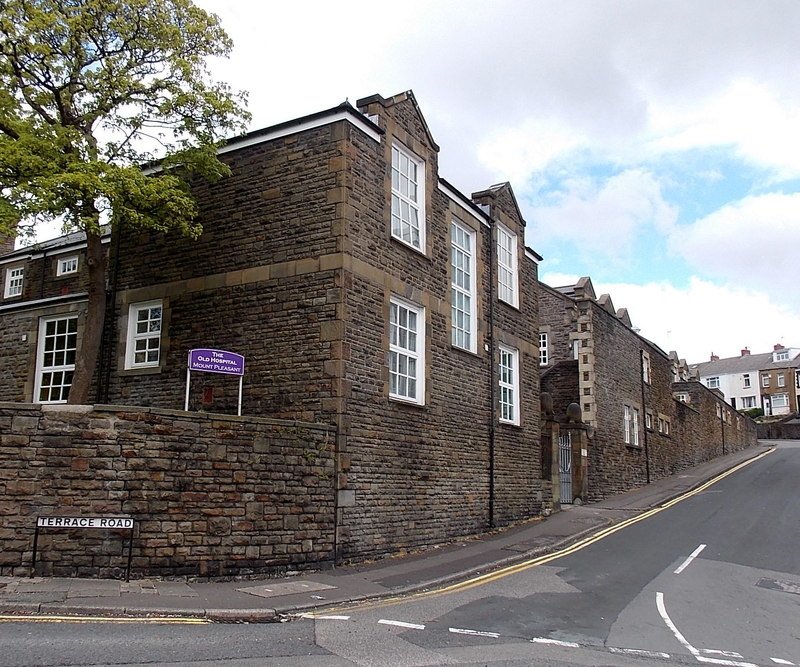
Victorian Swansea was a place of industry, migration, and hard labour — but also of deep precarity. While researching a recent commission, I uncovered a story that captures the reality of the Poor Law system in the mid–late 1800s. It is the story of one family, but it stands for thousands whose lives were shaped by illness, poverty, and the workhouse.
A Family on the Edge
The story begins with a man in his thirties, a journeyman butcher. He married in 1857 and by April 1868 he and his wife had six children, the youngest born just six months before his death. He developed kidney disease — a slow, debilitating decline — and spent two months in the Swansea Infirmary before dying in the spring of 1868.
His illness almost certainly stretched back far longer. Kidney disease often progresses over years, and it is likely he struggled to work for months, perhaps five years or more. By early 1867, the family’s income had effectively collapsed.
Within weeks of his death, the consequences were stark: his widow and all six children entered the Swansea Union Workhouse.
From Self‑Sufficiency to Absolute Poverty
This is the tragedy that defines so many Victorian working‑class lives. A family that had been managing — precariously, but managing — was plunged into destitution by a single death. There was no safety net, no sickness benefit, no widow’s pension. The Poor Law was the only recourse.
Once inside the workhouse, the family’s story becomes one of fragmentation.
The children were washed, their heads shaved, and placed under a strict institutional regime. The youngest child — an infant on admission — spent all his formative years inside. By age 11, he appears in the workhouse school register, still an inmate.
His mother, meanwhile, was repeatedly discharged and readmitted. Court records show she was charged with begging; she travelled east and west across the district, likely trying to survive outside the institution’s walls. She died in 1881, aged just 46, from heart disease.
Her youngest son — the child who spent ages 0–11 in the workhouse — eventually left Swansea, emigrated to the United States, changed his name, married a Welsh woman, and built a new life. He died in the 1930s in difficult circumstances. One can’t help wondering how deeply those early years shaped him.
The System Behind the Story
This family’s experience wasn’t an anomaly. It was the system working exactly as designed.
A Swansea newspaper article from 1858 described the workhouse conditions in shocking detail:
- severe overcrowding
- diseased inmates sharing narrow beds
- prostitutes, smallpox patients, and children in the same rooms
- stench and filth the surgeon said he had “no means of remedying”
- a building so inadequate that even the Guardians admitted it was unfit for purpose
The article called the workhouse “a disgraceful opprobrium” and urged the Board to build a new one — a debate that dragged on for years.
This was the environment into which the butcher’s widow and her six children were placed.
Why Stories Like This Matter
As genealogists, we often work with names, dates, and records. But behind every entry lies a life shaped by forces far larger than the individual.
This family’s story illustrates:
- how fragile Victorian working‑class life was
- how illness could destroy a household in weeks
- how the Poor Law system institutionalised children for years
- how survival often depended on resilience, luck, or escape
And it reminds us that the records we read — admission registers, school lists, court appearances — are fragments of real human experience.
A Final Thought
The youngest son’s journey — from the Swansea Union Workhouse to a new identity in America — is a testament to human endurance. But it also raises a question that lingers long after the research is done:
How much of a life is shaped by the first eleven years spent behind the walls of a Victorian workhouse?
If you’d like help uncovering the stories hidden in your own family history, I specialise in Welsh and UK research, combining archival work with narrative storytelling. You’re welcome to get in touch to explore what we might discover together.
Leave a Reply